ENGR 101 | University of Michigan
Guide to Using PrairieLearn
Overview
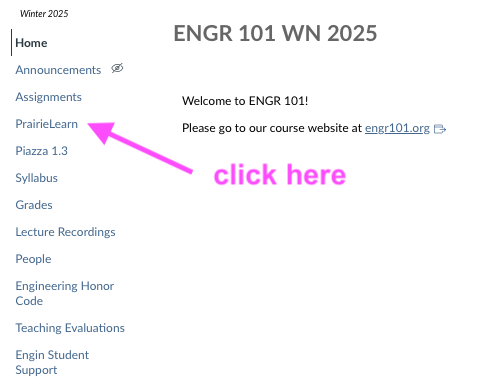
We will use the online platform PrairieLearn for a lot of our work in ENGR 101 this semester. The first time you go to PrairieLearn, use the link in Canvas:
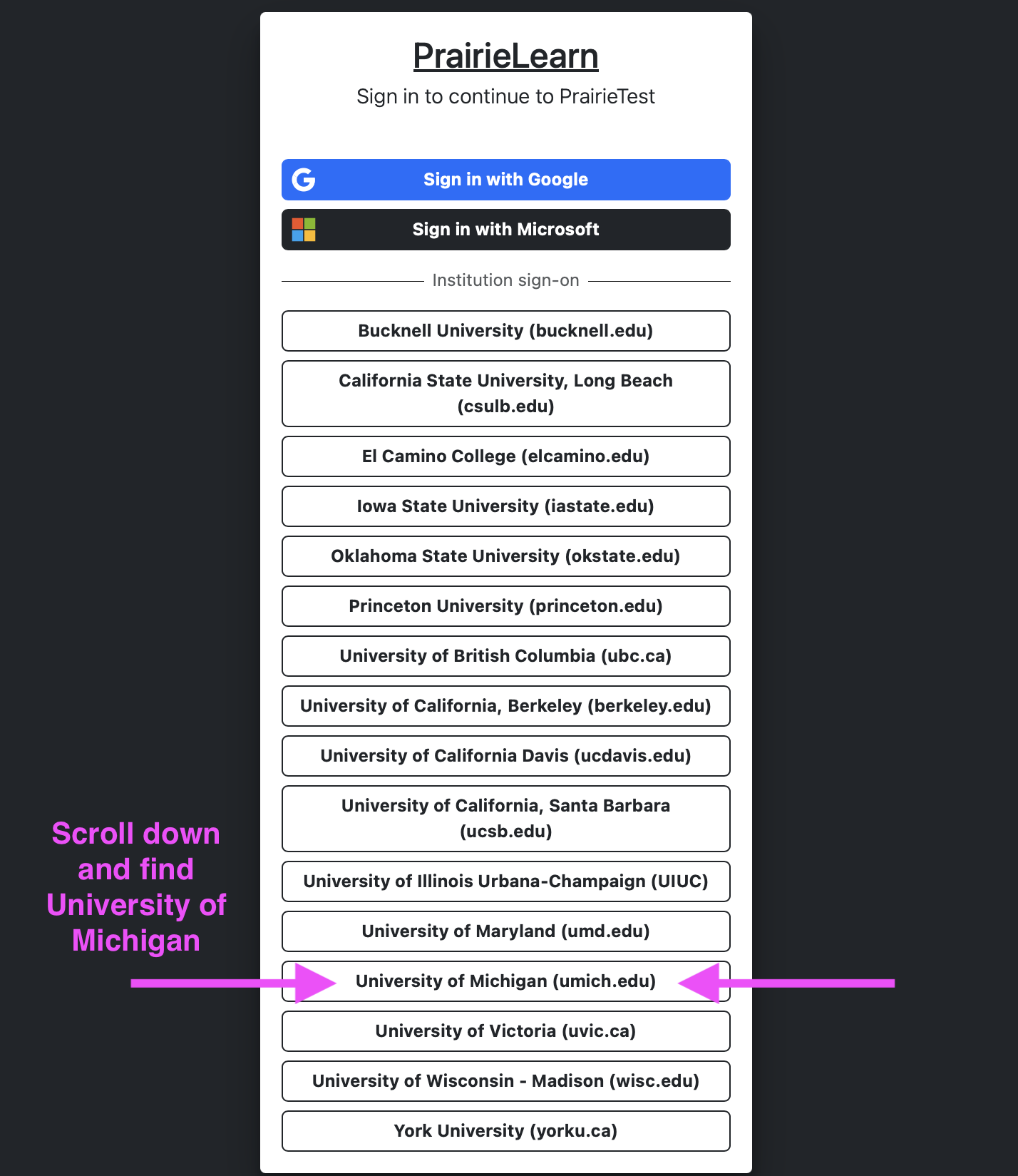
In the PrairieLearn login screen, scroll down to University of Michigan:
When you access PrairieLearn, you will see a screen that looks something like this image but with dates appropriate for this term:
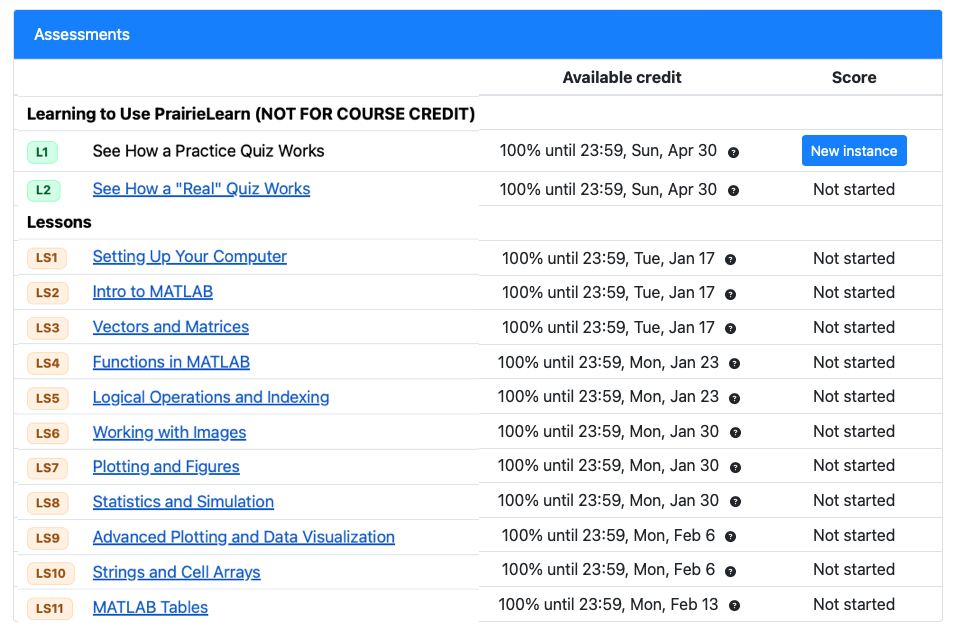
Click on the name of an assignment to get started on that assignment.
Types of ENGR 101 Assignments on PrairieLearn
All assignments on PrairieLearn are called “assessments”, which is fine because all of our assignments are really just there to help you assess your own understanding of course content. Only some of what you’ll do on PrairieLearn is a true “assessment” in the sense of being a quiz or exam.
We will use PrairieLearn for a variety of assignments:
- lessons
- lecture reflections
- labs
- project spec reviews
- quizzes and exams (including practice versions)
Lessons, lecture reflections, labs, and project spec reviews will work differently from quizzes and exams, so read on to learn more. Or, you can just go to PrairieLearn and start clicking on stuff! It should be pretty self-explanatory.
Lessons, Lecture Reflections, Labs, and Project Spec Reviews
Lessons, lecture reflections, labs, and project spec reviews have no time limit. The “Assessment Overview” (remember, all assignments are called “assessments” on PrairieLearn!) will show you the points for the assignment, the available credit, and the questions for the assignment:
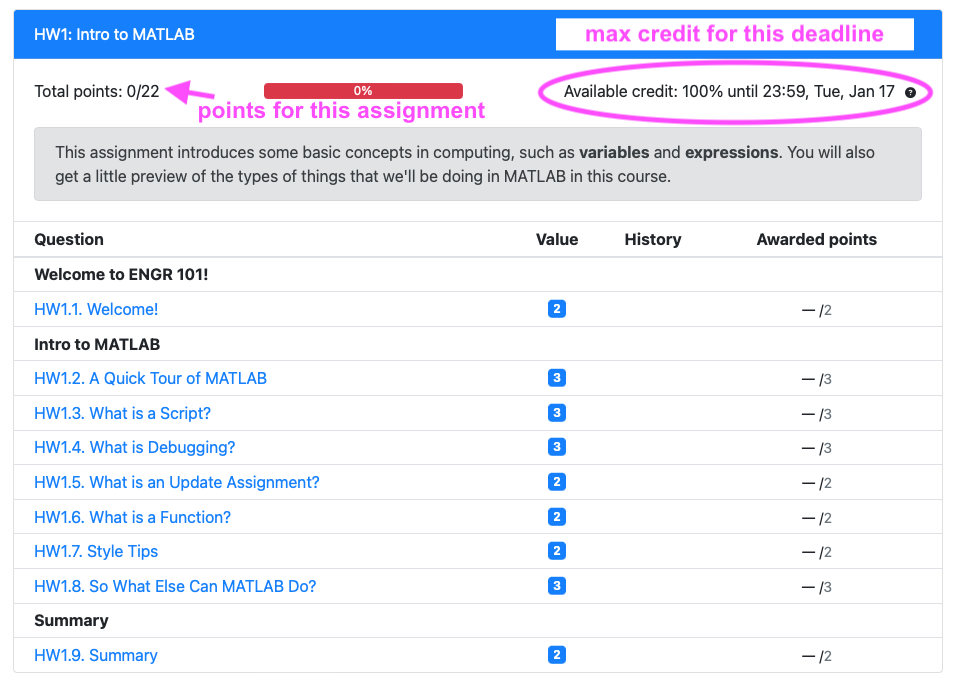
PrairieLearn will automatically apply the grade caps for late submissions, so if you complete an assignment after its original due date, you will see something like: Available credit: 95% until 23:59, <Day>, <Date>.
The lessons, lecture reflections, labs, and project spec reviews are meant for learning, so we’ve given you unlimited attempts for each question:
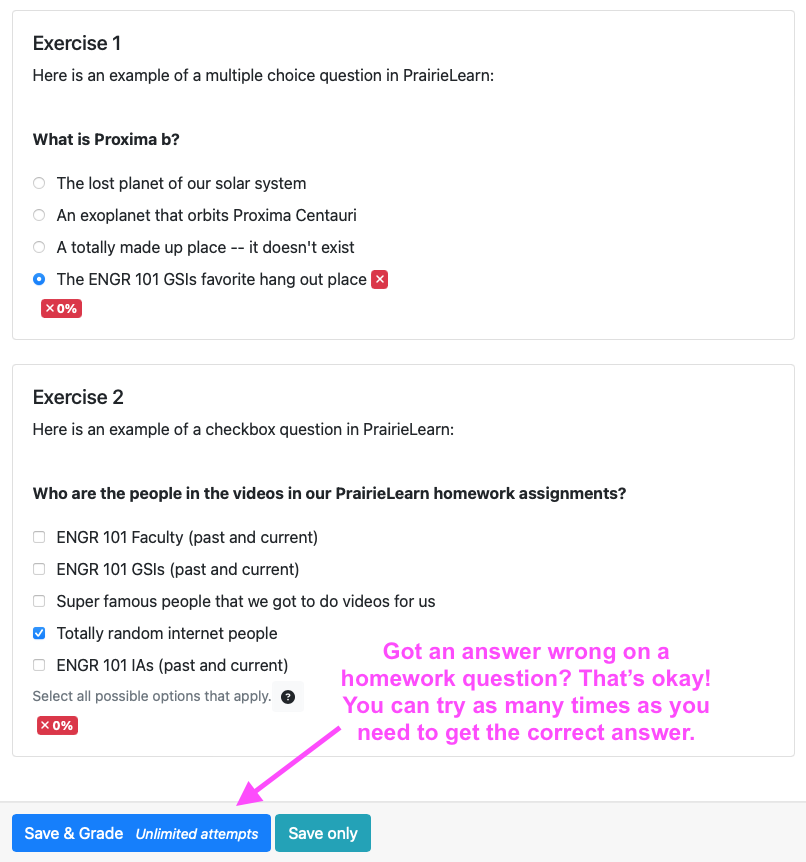
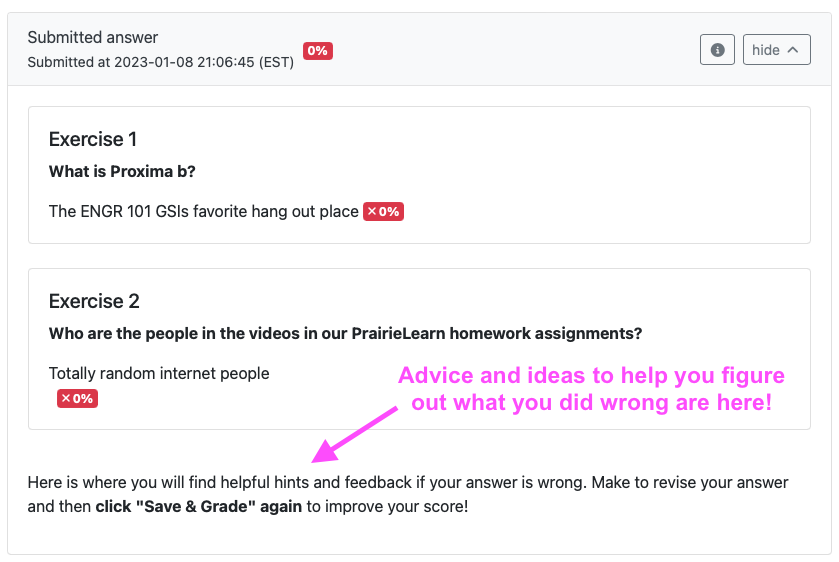
If you get an answer wrong, scroll down to the “Submitted answer” box for some help, advice, and ideas about what to look for to correct your answer:
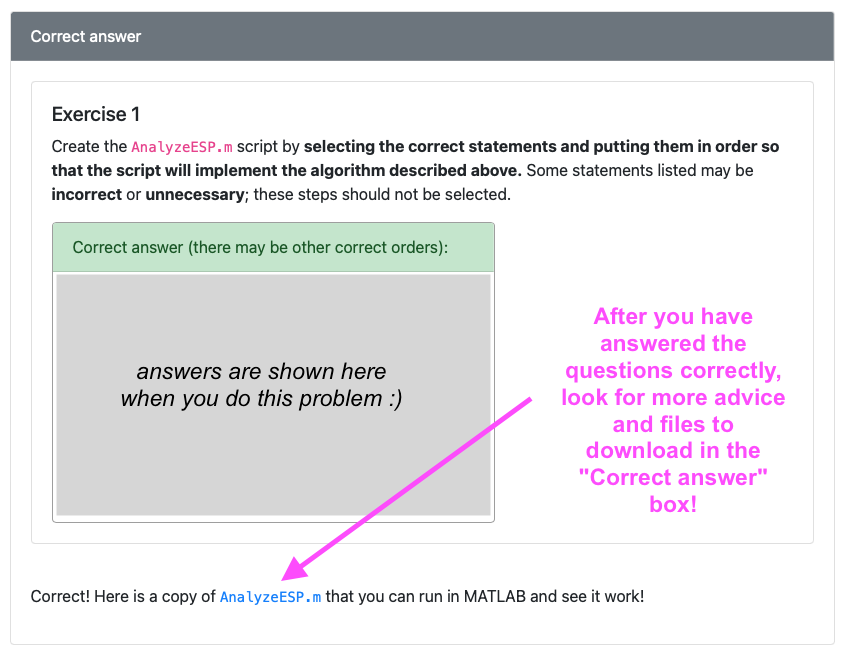
After you have answered the questions correctly, check out the “Correct answer” box for more advice, feedback, and copies of programs for you to download and add to your set of ENGR 101 example code. A lot of what you will do in the lessons and lecture reflections will be directly helpful in lab and on projects!
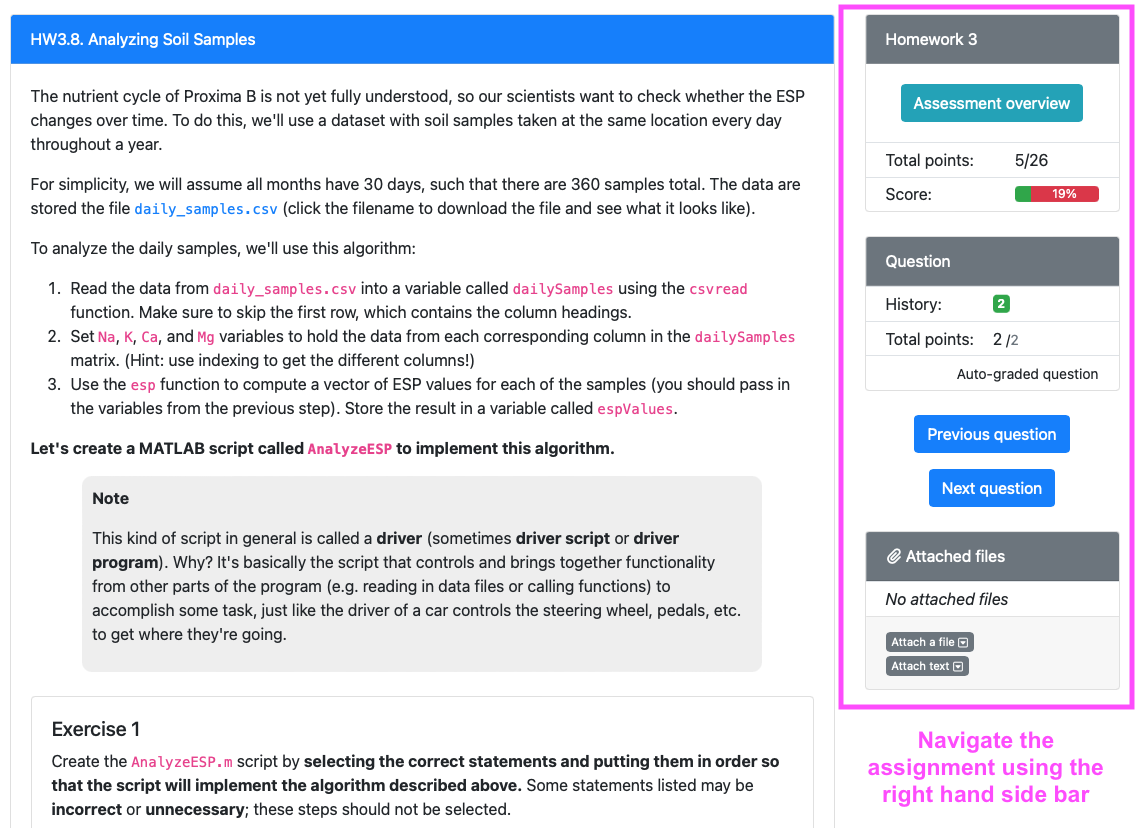
We recommend doing the questions in order for a given lesson, lecture reflection, or project spec review, but you don’t have to if you don’t want to. You can navigate through the assessment using the right hand side bar:
The labs are done as a group and are structured assuming you are doing each question in order.
That’s pretty much it for lessons, lecture reflections, labs, and project spec reviews! If you run into any problems, come to office hours or post on Piazza.
Assessments (Quizzes and Exams)
Quizzes and exams will be timed and taken at the Engineering Testing Facility. You can learn more about how to take quizzes and exams in the Quiz & Exam Logistics document.
Each assessment will consist of two sections:
- Skills Assessment
- Applications
Skills Assessment questions are questions that check your ability on the fundamental programming skills that the assessment is covering. These questions are, in fact, the same questions that are in the practice set assignments. This is on purpose! We want you to have the opportunity to prove to yourself, and us, that you are confident in these fundamental skills.
Applications questions are code-writing questions. You will be given an engineering/science scenario with an algorithm to implement. These questions are very similar to, but not exactly the same as, the code writing questions on the practice assessments. Your code will be evaluated against test cases, similar to how your lab and project code is evaluated on the Autograder.
Practice Assessments
All quizzes and exams have practice versions that will be available on PrairieLearn. You may take the practice versions as many times as you want; the grades for practice quizzes and exams do not count towards your course grade.
As part of your preparation for each quiz and exam, you are expected to have done at least one practice version so that you are familiar with the types of questions that will be on the actual quiz/exam.
Taking a Practice Assessment
You can take a practice assessment anywhere. You do not need to go to the Engineering Testing Facility for a practice assessment.
Let’s go through taking a practice assessment using Practice Quiz 1 in PrairieLearn.
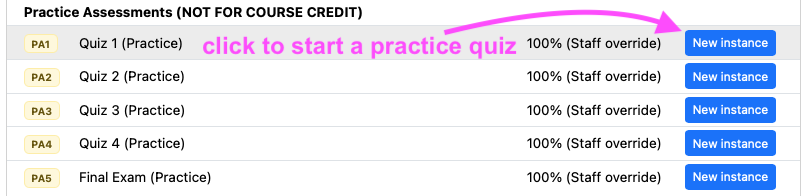
In PrairieLearn, scroll down to the Practice Assessments section. For the Quiz 1 (Practice) assignment, click the “New Instance” button to start a practice quiz for Quiz 1:
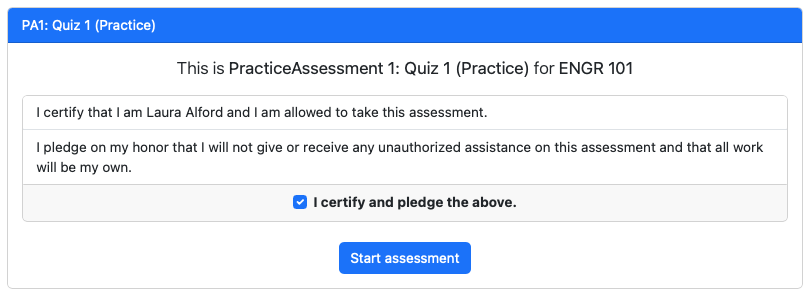
Verify that you are in the right spot (Quiz 1 Practice) and sign an abbreviated honor pledge:
The assessment overview will show you how everything is set up for the quiz:
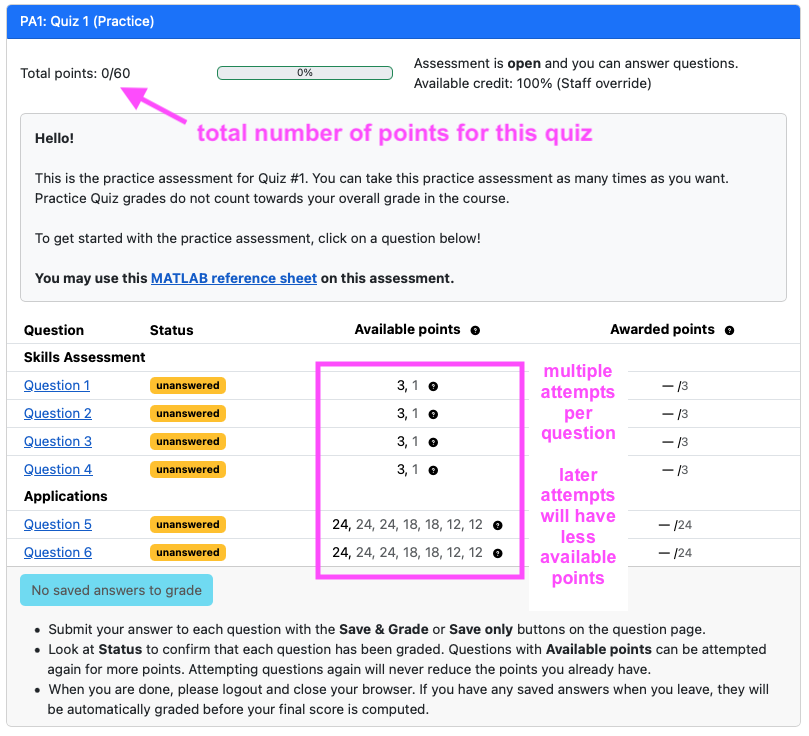
The quizzes are worth 60 points. One big difference from the other PrairieLearn assignments is that quizzes and exams are timed. ETF assessments are 50 minutes, so these practice quizzes are also 50 minutes. If you have assessment accommodations for extra time, this accommodation will be reflected in the practice quiz as well as anything you take in the ETF.
Another big difference is that quizzes and exams have multiple, but limited, number of attempts per question. The assessment overview shows you how many attempts you have for each question.
It is VERY IMPORTANT that you are familiar with any reference sheets that are included with your assessment.
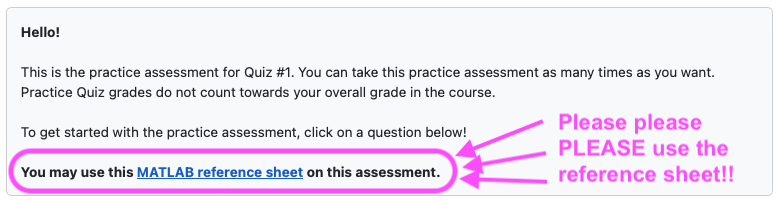
We are expecting you to be able to quickly find code examples to copy and paste from the reference sheet into your own code in the assessment and then adapt those examples to work with your own code in the question. Re-using working code is an important programming skill!
Click on a question link to get started with the quiz:
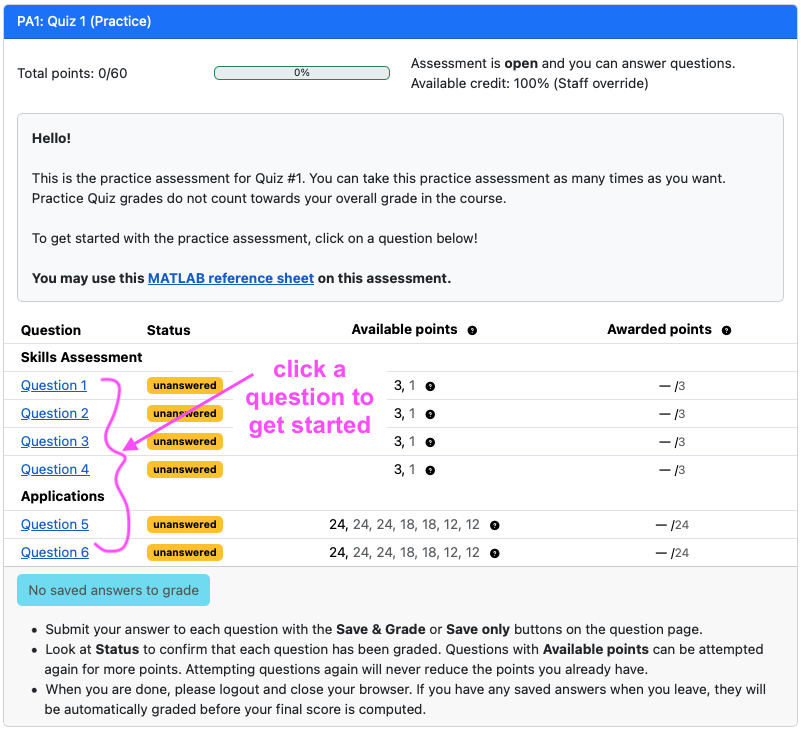
You can complete the questions in any order, and if you get stuck on one question, you can go to another question and come back to the other question later.
Each question will show you how many attempts you have left, how many points the current attempt is worth, and how many points the next attempt would be worth.
Skills Assessment Question Example
Here is an example of what the “points per attempt” information looks like for one of the Skills Assessment questions:
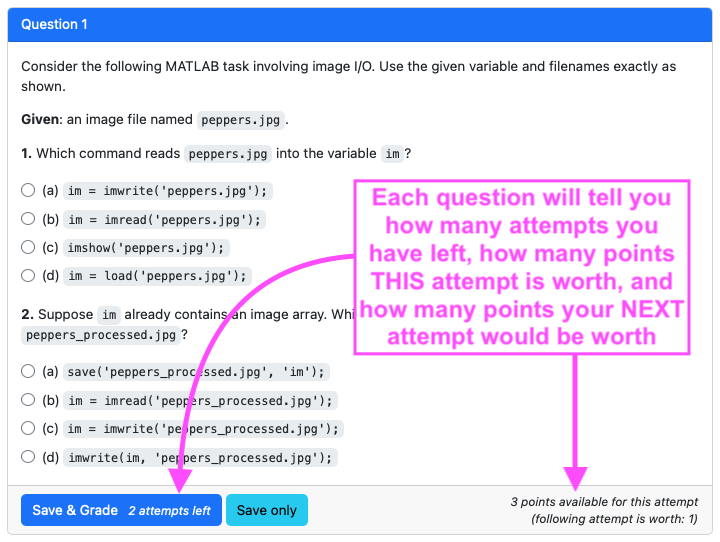
After you have answered the question, click Save & Grade just like you do in lessons and labs.
Applications Question Example
The Applications questions, where you write code, will look similar in terms of knowing how many attempts you have and for how many points. For a MATLAB code-writing question, it will look like this:
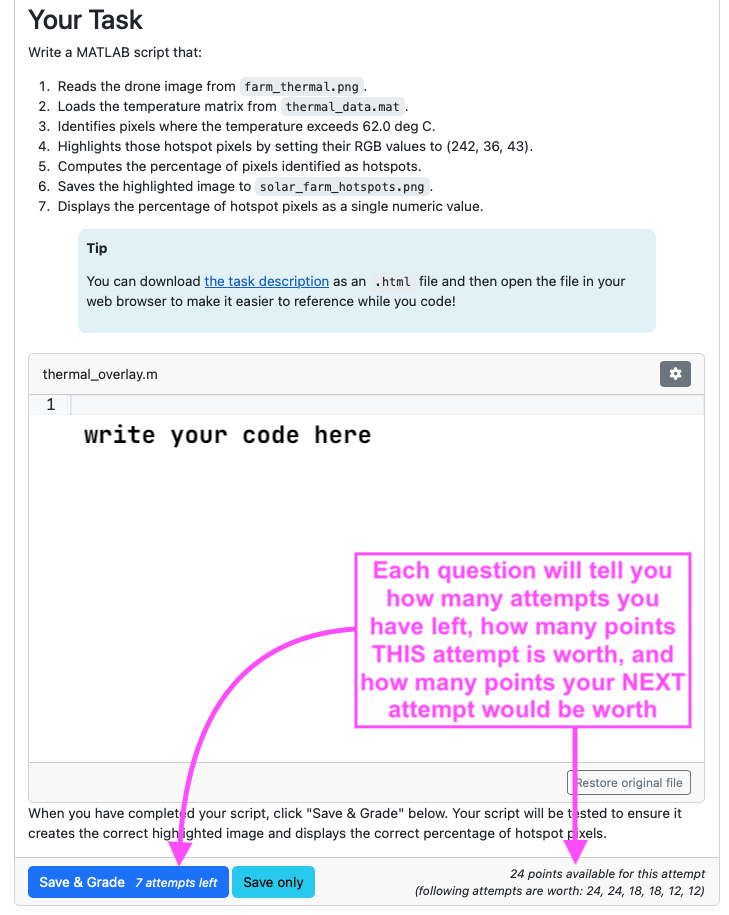
There will be a detailed description of what you need to do, which you can also download as an .html file and then re-open in a new browser window so you have have it side-by-side with where you are typing your code. There will be a text box where you write your code.
We strongly recommend that you copy-and-paste as much as you can when writing your code, either from the question’s task description or from the Reference Sheet. This will help you avoid typos and mixing up one coding approach with another.
When you have completed your answer, click Save & Grade. The grading process will then start to evaluate your code. At this point you will see a small box that says “Grading in progress”:
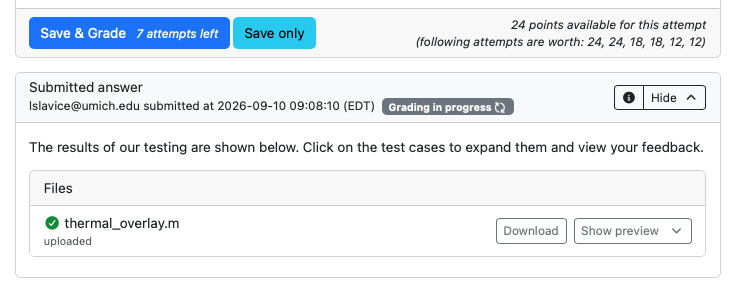
The grading process does take a few seconds, especially for MATLAB questions since MATLAB is an interpreted language. You may safely go to another question while waiting for the grading process to finish. If it has been 30 seconds or so and the grading process hasn’t completed, try refreshing the page because sometimes the automatic page refresh doesn’t happen.
After the grading process is complete, you will see your results. Here is an example where the code failed every test case:
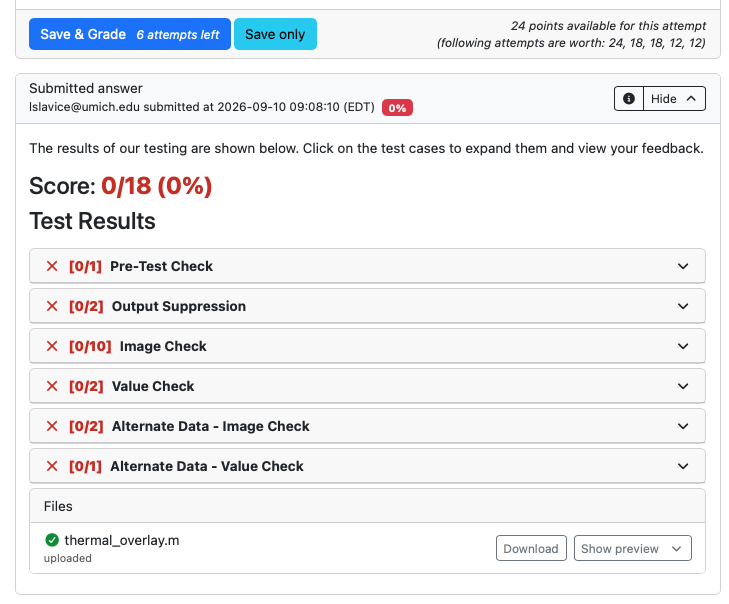
You can (and should!) expand each test case to get more information on the test case and feedback if the test failed. Some test cases look for common bugs, such as mistyping a file name or label for a plot. Here is an example of the results of a “Pre-Test Check” test:
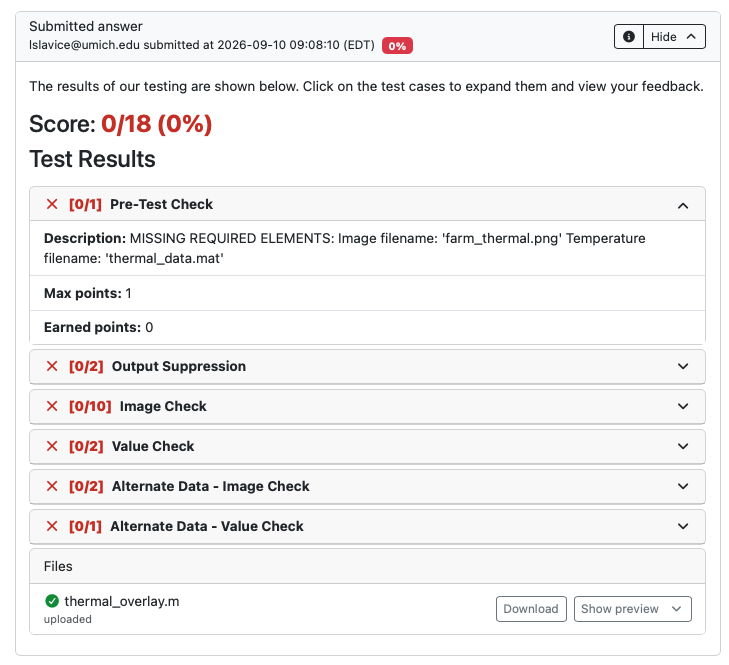
In this case, the Pre-Test Check feedback says that it couldn’t find two filenames that must be there for the code to work: farm_thermal.png (which was the name of the file that has the original image) and thermal_data.mat (which was the name of the data file). Most likely this means that we have a typo in those filenames, so we would start by checking that in our code.
The other test cases will also have helpful feedback. Here is an example of a submission that passes the Pre-Test Check now (yay!) but has errors when it runs:
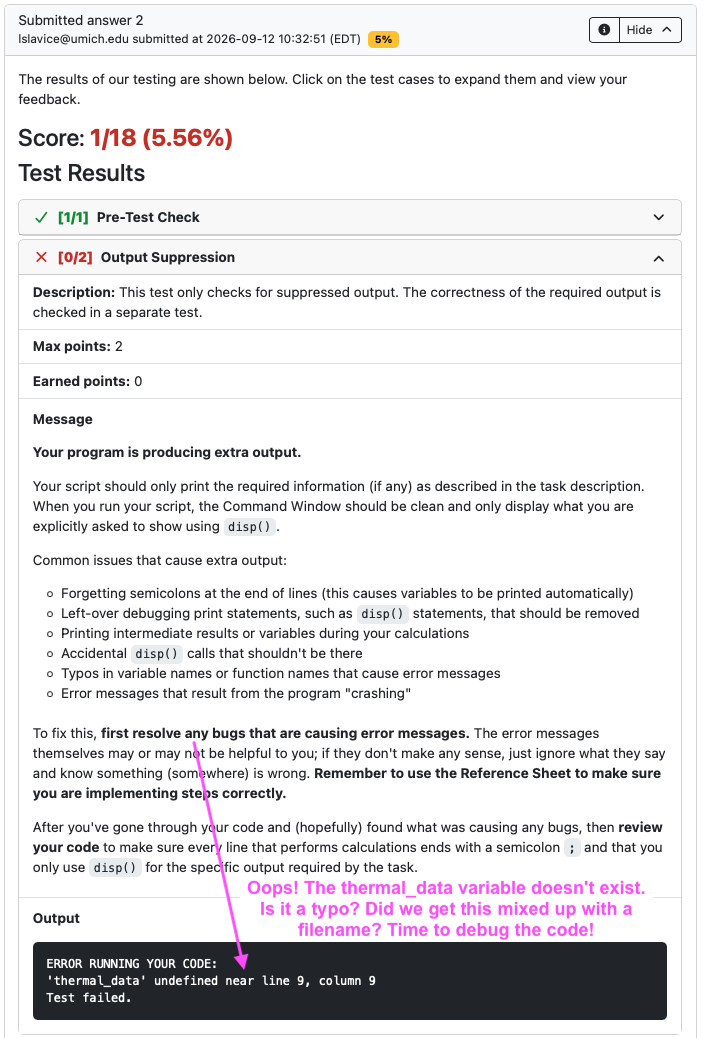
Use the feedback and program output to help you track down where your bug is and fix it. In the case above, the error message says that thermal_data is undefined. “Undefined” here means that we tried to use a variable before the variable exists – likely because we mistyped the variable name or we missed a step in implementing the algorithm.
Error messages are sometimes helpful, and sometimes they are not! If you see an error message that doesn’t make sense to you, that’s okay. The error message just indicates that something isn’t working correctly in your code. There will be some suggestions on what might be wrong, but really you should just carefully review your code line-by-line and make sure you are correctly implementing each step of the algorithm.
Additional test cases will check that your code produces the correct output. Make sure that you carefully review the test case feedback because small errors in your code may produce results that seem correct at first glance, but are incorrect. For example, consider the results of this image check:
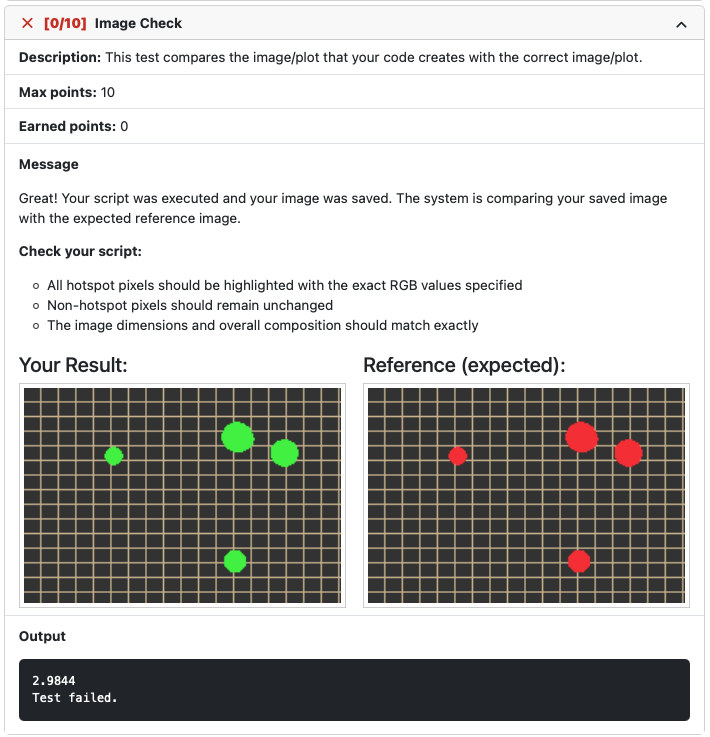
In this case, it is fairly obvious that this code submission produced the image incorrectly: there are green spots instead of red spots!
Now consider the grading results of another attempt for this same question we’ve been working with:
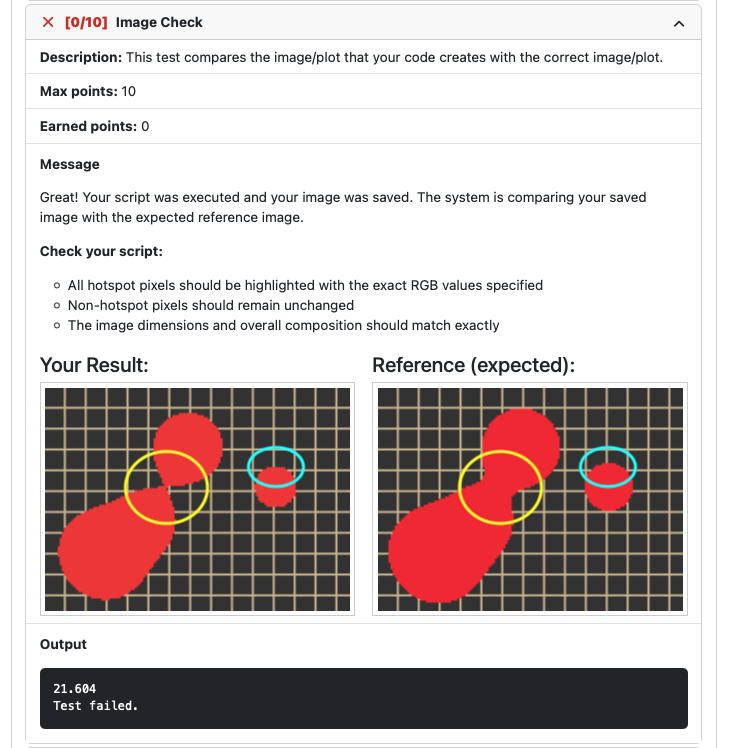
If you just looked quickly at these two images side-by-side, you might think that they are the same. But look more closely at the two areas circled in the images (one set yellow, one set teal). You can see that there are differences, so something in the code is not producing the correct results. It looks like it’s close but not quite there. Be detail-oriented in your code writing! Even a small difference, such as typing a value of 0.012 instead of the specified value of 0.021, will cause your program to produce incorrect results!
Checking Your Assessment Overview
At any time, you can return to the Assessment Overview and see the status of all your questions:
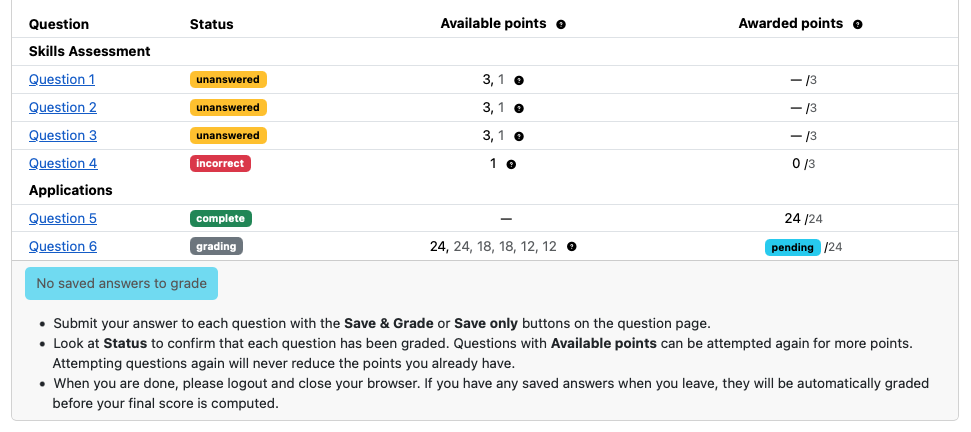
The Assessment Overview will show you any available points that you still have for each question. If a question is still being graded, such as Question 6 in this case, its status will be grading and the awarded points will say pending. This is expected behavior and will be updated/resolved as soon as the grading process is complete.
Completing the Practice Assessment
Your goal is to complete all of the questions within the allowed time. A completed assessment will look something like this:
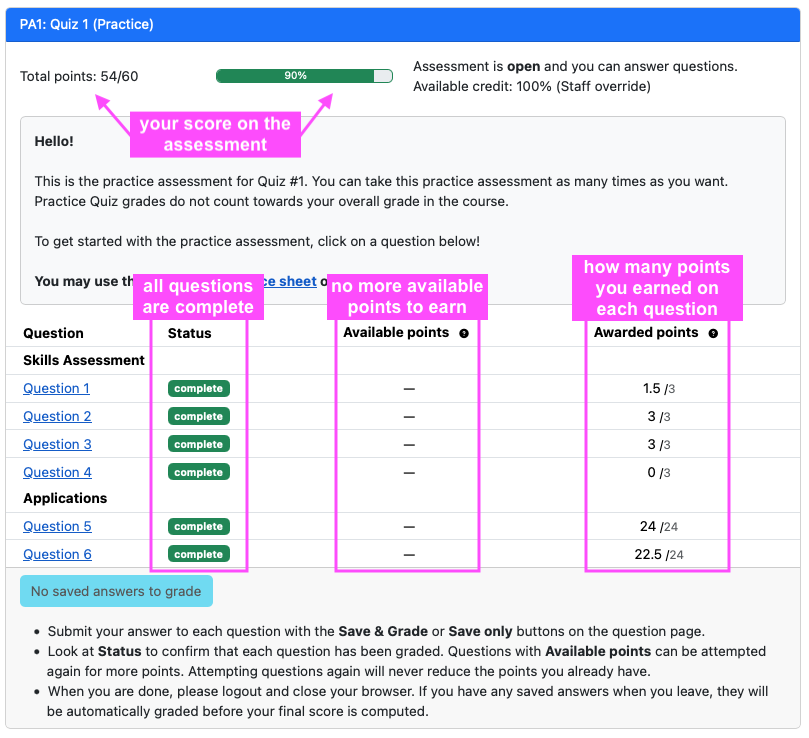
The Assessment Overview would show that all questions are complete with no remaining available points. The Overview will also show you how many points you earned on each question and your total score for the assessment.
Congratulations! You have completed a practice quiz!
Reviewing Your Practice Assessment
After your practice assessment ends, you are able to review each of the questions and your answers. If you didn’t finish the practice quiz before the time ran out, review the questions to figure out what concepts or skills you are still a little fuzzy on.
After you identify what topics you need to review before taking the actual quiz or exam, check out the lessons, labs, and lecture exercises that practice those topics. You can come to office hours and ask for additional examples or explanations, and you can ask a friend to help you review.
A well-prepared student will be comfortable with all the skills and topics covered by the assessment. They will also be able to quickly find the relevant examples in the Reference Sheet. You do not need to memorize anything!
If you try to learn the course material while you are taking the assessment, you will run out of time. Make sure you are well-prepared!
Taking the Quizzes and Exams in the ETF
The actual quizzes and exams will look and feel just like their practice versions. You just have to come to the Engineering Testing Facility (ETF) and take the assessments there so that we (and you!) have assessment results that are valid across the entire class.
The ETF is truly not intended to be a scary or intimidating place. But we understand that anytime you go to take a test it is at least a little nerve-wracking, and sometimes it’s REALLY nerve-wracking!
Doing multiple practice assessments for each quiz or exam is both a great way to identify areas to brush up on in your preparation and to build up your confidence and comfort level with the questions themselves.
Additionally, you should carefully review the Quiz & Exam Logistics document to understand exactly how the ETF works and what you can expect when you go there for the first time.
You are expected to know and understand all of the procedures and policies of the ETF prior to taking an assessment at the ETF. “I didn’t know about that” is not acceptable excuse and you may run the risk of being reported for an honor code violation.
If you have any questions about taking an assessment at the ETF, please post them to Piazza and we will help clarify things. If you have a question about the ETF, someone else in the class is probably wondering about the same thing!